

Claudia Rabaioli alla Mediterranean Machine Learning (M2L) Summer School
Claudia Rabaioli took part in the recent edition of the Mediterranean Machine Learning (M2L) Summer School, to be held in Split, Croatia, from 8 to 12 September 2025.
Could you briefly tell us what the school’s theme is and why it is relevant?
The Mediterranean Machine Learning (M2L) Summer School is an intensive five-day programme dedicated to the main research topics in the field of machine learning, with a particular focus on the latest developments in deep learning and large language models. On the one hand, it offers high-level technical training, thanks to international speakers, lectures and practical sessions; on the other, it creates a space for building an international scientific community amongst students, researchers and experts.
M2L offers an important opportunity to engage with leading professionals and discuss the current and future challenges facing AI. Furthermore, the Department of Computer Science at the University of Milan-Bicocca co-organised one of the previous editions: for us, therefore, this school also represents an opportunity for continuity and dialogue with an internationally recognised initiative.
In particular, what do you do, and why did you choose to take part in the course?
Teoria e Tecnologia della Comunicazione . I am currently in my first year of a PhD in Computer Science at the Department of Computer Science, Systems and Communication (DISCo) at the University of Milan-Bicocca. My academic background is somewhat different from that of many other PhD students in the department: I obtained my Master’s degree in Communication Theory and Technology, also at Bicocca; before that, I completed a Bachelor’s degree in New Technologies in Art at the Santa Giulia Academy of Fine Arts in Brescia.
My work today seeks to bring these diverse worlds together through a multidisciplinary approach: I use models and algorithms to study people’s behaviours and affective states, such as emotions and mood. In particular, I am developing systems which, through questionnaires and the recognition of physiological signals, can provide personalised audiovisual content to support mental wellbeing.
I chose to take part in the M2L Summer School primarily to broaden my skills in the field of machine learning, but also to receive feedback on my work and build connections with researchers who share similar interests.
Was registration a given, or was it not obvious that you could take part?
It was by no means a foregone conclusion: out of over 1,700 applications, only 300 students and researchers were selected. Being part of this group was a significant honour for me, which made the experience all the more meaningful.
Were the students merely there as observers, or were there any activities in which you played an active role?
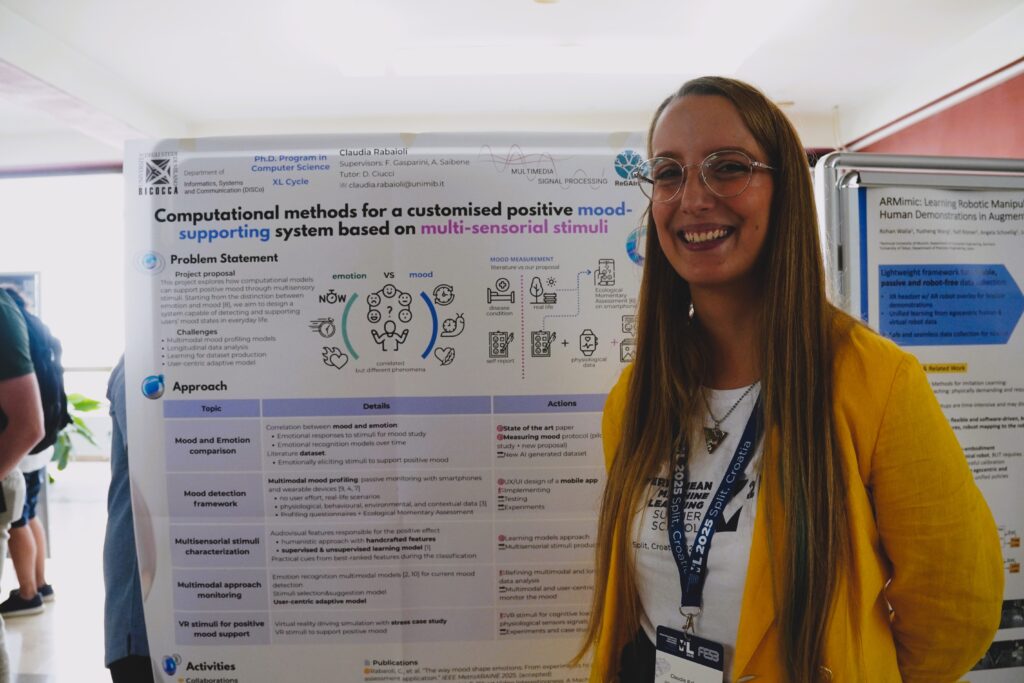
The students were not merely observers: as well as attending lectures and tutorials, we had the opportunity to present our work during the poster sessions. I presented my poster, entitled ‘Computational methods for a customised positive mood-supporting system based on multi-sensory stimuli’, outlining my PhD project. It was a valuable opportunity to receive feedback, strike up conversations with other researchers who share similar interests, and gather useful suggestions for taking my research forward.
Which lectures or seminars made the biggest impression on you? Did you gain any useful insights for your research?
What struck me most were not just the lectures, but the people: I met some brilliant researchers – both men and women – with whom I hope to stay in touch, and who made the experience all the more enriching. Furthermore, the strong female presence amongst the speakers (11 out of 18) was particularly inspiring in a technical and scientific context.
Among the content, Sander Dieleman’s lectures on diffusion models particularly stood out to me, thanks to his ability to explain complex concepts clearly from both a theoretical and a practical perspective. Lydia Chen’s presentation on watermarking AI-generated content was also very thought-provoking, addressing a crucial issue for traceability and authenticity. Finally, the open debate led by Julia Haas on security and ethics provided a forum for reflections – which are often sidelined (unfortunately!) – on how to translate moral principles into concrete practices in AI development, a topic that ties in directly with ReGAInS’s objectives.

Leave a Reply